Developer API Access & Key Management Guide
Enterprise 3-tier integration guide: interactive 5-minute quickstart, 6-stage visual lifecycle onboarding, least-privilege permission scopes, high-entropy credentials, and real-time signed event streaming.
Architecture & Zero-Trust Perimeter
The KeyPriv Developer Platform provides a secure, least-privilege REST API and real-time event delivery stream designed for SIEM, SOAR, ITSM, and SOC automation pipelines. Developer Applications operate under an air-gapped, zero-trust security perimeter: credentials never access other organizations, and keys are cryptographically hashed using SHA-256 before storage.
Tier 1: 5-Minute Quickstart & Interactive Playground
Test live requests instantly against either the Production or Sandbox environment using the interactive code runner below. Toggle environments to see prefix and host updates in real-time.
curl -X GET "https://app.keypriv.com/v1/intelligence/findings?limit=50&severity=critical" \
  -H "X-API-Key: kpv_prd_YOUR_KEY_HERE" \
-H "Accept: application/json"{
"total": 124,
"limit": 50,
"has_more": true,
"next_cursor": "eyJpZCI6ImV4YW1wbGUtY3Vyc29yIn0=",
"items": [
{
"id": "fnd_sample_01",
"threat_type": "credential_exposure",
"severity": "critical",
"compromised_domain": "example.com",
"source_leak": "Dark Web Intelligence Dump #102",
"discovered_at": "2026-10-12T19:45:00Z"
},
{
"id": "fnd_sample_02",
"threat_type": "exposed_subdomain_takeover",
"severity": "high",
"compromised_domain": "vpn-staging.example.com",
"source_leak": "Dark Web Intelligence Dump #102",
"discovered_at": "2026-10-12T18:20:12Z"
}
]
}Tier 2: Visual 6-Stage Walkthrough & Lifecycle Onboarding
Developer Applications follow a structured security progression. A new application is securely onboarded across 6 stages to guarantee that credentials, least-privilege scopes, and delivery endpoints are fully verified before promoting the integration to active status:
Application Onboarding & Lifecycle Progression
Identity & Target Environment
Registers the application identity, environment plane (Production or Sandbox), and consumer architecture (SIEM, SOAR, ITSM, or custom backend).
- Name length 3–80 characters
- Unique name within organization
- Target environment selected
- app_name (String)
- app_type (Enum)
- env (production | sandbox)
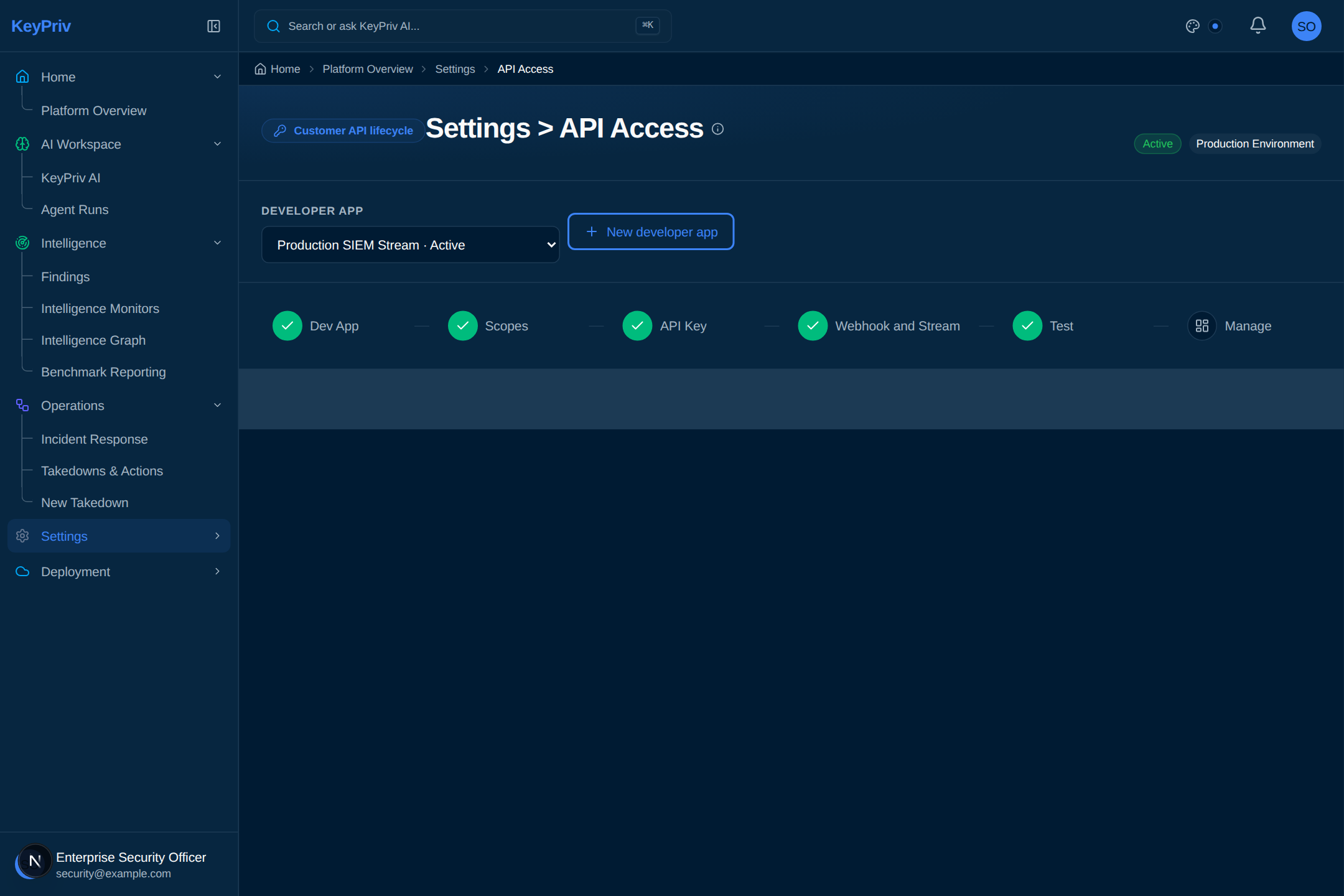
Navigate to the developer settings panel to begin onboarding your application.
- In the platform sidebar, expand Settings and click API Access.
- If this is your first application, the system displays the Developer App Lifecycle Rail in draft mode.
- Click Start developer app (or New developer app) to initialize your workspace draft.
Registers the identity, target environment, and integration type for your developer app.
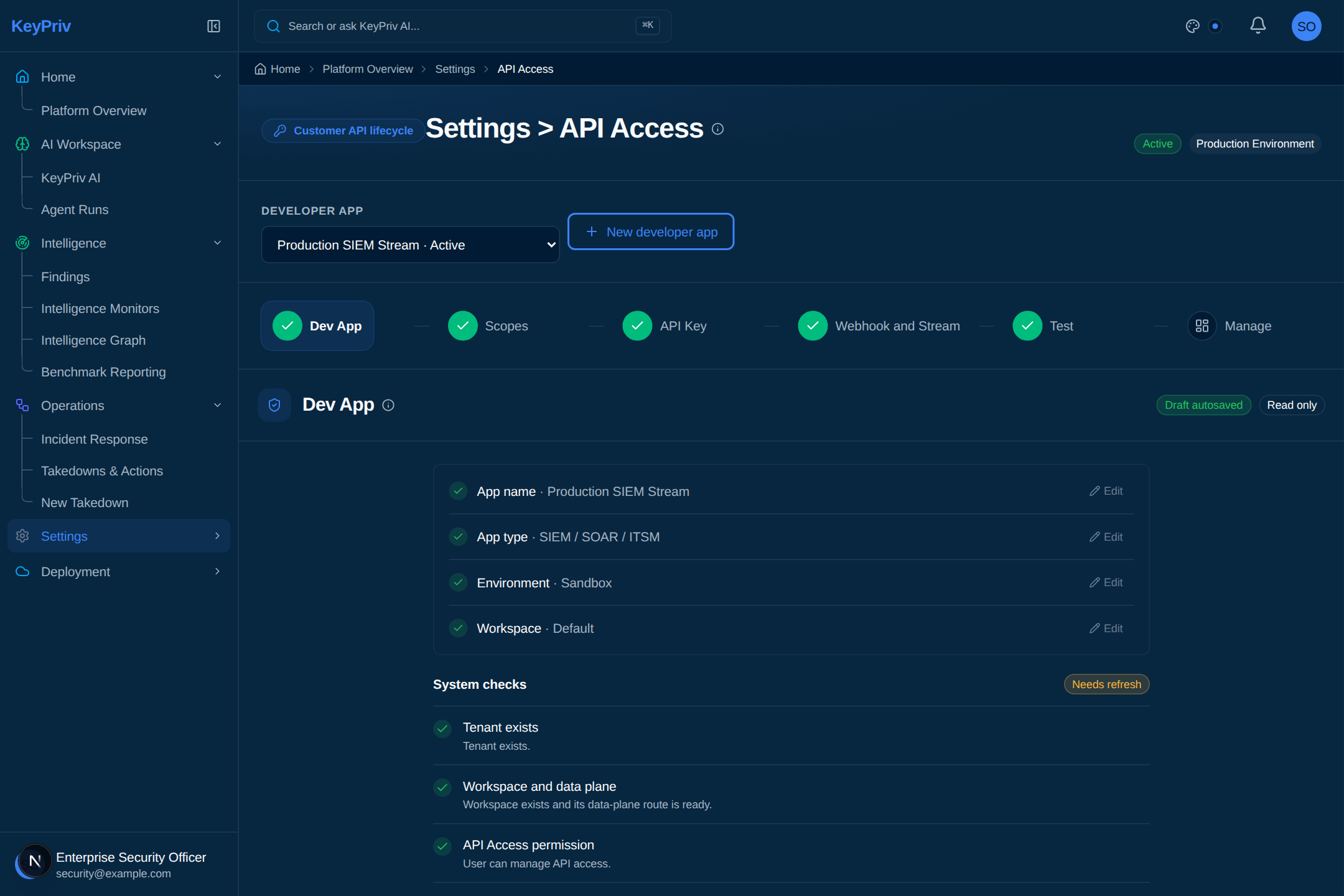
Step 1 Configuration Schema (Tri-View)
| Parameter | Type | Requirement | Description & Rules | |
|---|---|---|---|---|
app_name | string | Required | Descriptive human-readable identifier for your integration. Rule: 3–80 characters, alphanumeric, spaces, hyphens |
| Parameter | Type | Requirement | Description & Rules | |
|---|---|---|---|---|
app_type | enum | Required | Architecture type of consumer connecting to KeyPriv. Rule: 'SIEM / SOAR / ITSM' | 'Custom backend' | 'Partner app' | 'CLI / Script' | 'Other' | |
env | enum | Required | Target security and network isolation plane. Rule: 'production' | 'sandbox' |
Tier 3: Security Hardening & Technical Reference
Production hardening standards for enterprise automation: cryptographic authentication, granular scope isolation, HMAC webhook verification, rate limiting, and standard HTTP error codes.
Authentication
Authenticate all HTTP REST and SSE requests by passing your API key in the X-API-Key request header.
Required Authentication Headers (Tri-View)
| Parameter | Type | Requirement | Description & Rules | |
|---|---|---|---|---|
X-API-Key | string | Required | High-entropy secret key generated in Step 3. Rule: Format: kpv_prd_... (production) or kpv_sbx_... (sandbox) |
| Parameter | Type | Requirement | Description & Rules | |
|---|---|---|---|---|
Accept | string | Required | Content negotiation header defining the response representation. |
/v1/intelligence/findingsRetrieves paginated intelligence findings, compromised credentials, and threat signals correlated to your organization assets.
Query Parameters (Tri-View)
| Parameter | Type | Requirement | Description & Rules | |
|---|---|---|---|---|
limit | integer | Optional | Maximum findings to retrieve per page. Rule: 1–500 records | |
cursor | string | Optional | Opaque pagination cursor for forward traversal. Rule: Base64 encoded pagination token |
| Parameter | Type | Requirement | Description & Rules | |
|---|---|---|---|---|
severity | enum | Optional | Filter findings by severity level. Rule: 'critical' | 'high' | 'medium' | 'low' | |
source_type | string | Optional | Filter findings by dark web or exposure source type. Rule: 'darkweb' | 'paste' | 'forum' | 'email_leak' | 'network_scanner' |
/v1/stream/eventsOpens a persistent Server-Sent Events (SSE) connection that pushes findings and correlation alerts to your pipeline in real-time.
curl -N -H "X-API-Key: kpv_prd_YOUR_KEY_HERE" \
  -H "Accept: text/event-stream" \
  "https://app.keypriv.com/v1/stream/events?app_id=YOUR_APP_ID"
Webhook Event Delivery Schema
When configured for outbound webhooks, KeyPriv sends strongly typed event notifications to your HTTPS endpoint. Every event follows this standardized schema:
Webhook Event Delivery Schema (Tri-View)
| Parameter | Type | Requirement | Description & Rules | |
|---|---|---|---|---|
event_id | string | Required | Cryptographically unique UUIDv4 identifying the delivery event. Rule: UUIDv4 format | |
event_type | enum | Required | Classification of threat or system intelligence notification. Rule: 'finding.created' | 'finding.updated' | 'finding.remediated' | 'key.rotated' | |
timestamp | string | Required | ISO 8601 UTC timestamp when the event was emitted by the platform. Rule: RFC 3339 / ISO 8601 format | |
correlation_id | string | Required | Traceability identifier correlating this delivery to source threat intelligence. Rule: UUIDv4 format | |
attempt | integer | Required | Delivery attempt sequence count. Automatically advances up to 5 during retries. Rule: 1–5 |
| Parameter | Type | Requirement | Description & Rules | |
|---|---|---|---|---|
data+5 nested | object | Required | Structured event payload containing affected asset domains, severity metrics, and incident details. |
Scope Permission Matrix
Scope Permission Specification (Tri-View)
| Parameter | Type | Requirement | Description & Rules | |
|---|---|---|---|---|
findings:read | scope | Optional | Query active and archived breach intelligence findings, compromised employee credentials, and exposure signals. Rule: Read-Only privilege level | |
threats:read | scope | Optional | Access global dark web intelligence feeds, threat actor profiles, and IOC feeds. Rule: Read-Only privilege level |
| Parameter | Type | Requirement | Description & Rules | |
|---|---|---|---|---|
events:stream | scope | Optional | Subscribe to real-time Server-Sent Events (SSE) notification streams for automated SOAR ingestion. Rule: Streaming privilege level | |
remediation:write | scope | Optional | Trigger automated asset quarantine, DSAR takedown workflows, and case status transitions. Rule: Write privilege level |
HMAC Webhook Signatures
Every webhook delivery dispatches an X-KeyPriv-Signature header computed as sha256=HMAC-SHA256(secret, rawPayload). Always verify this signature in constant time before parsing JSON:
import hmac, hashlib

def verify_webhook(raw_payload: bytes, signature_header: str, secret: str) -> bool:
    expected = "sha256=" + hmac.new(secret.encode(), raw_payload, hashlib.sha256).hexdigest()
    return hmac.compare_digest(expected, signature_header)
Rate Limits & Quotas
The API gateway enforces a token-bucket algorithm at the organization level:
1,000
Requests per minute per key
25
Concurrent event streams per app
72h
Dead-letter replay buffer
HTTP Error Codes & RFC 7807 Standard Error Schema
KeyPriv returns RFC 7807 Problem Details for HTTP APIs with machine-parseable error codes:
RFC 7807 Problem Details Schema (Tri-View)
| Parameter | Type | Requirement | Description & Rules | |
|---|---|---|---|---|
type | string | Required | URI reference identifying the specific RFC 7807 error problem type. |
| Parameter | Type | Requirement | Description & Rules | |
|---|---|---|---|---|
title | string | Required | Short, human-readable summary of the problem category. Rule: e.g. Invalid Request Payload | |
status | integer | Required | HTTP status code corresponding to the error. Rule: 400 | 401 | 403 | 429 | 500 |
| Parameter | Type | Requirement | Description & Rules | |
|---|---|---|---|---|
detail | string | Required | Human-readable explanation specific to this error occurrence. | |
code | string | Required | Machine-parseable enterprise error code for automated SIEM handling. Rule: 'INVALID_PAYLOAD' | 'MISSING_OR_INVALID_KEY' | 'INSUFFICIENT_SCOPE' | 'RATE_LIMIT_EXCEEDED' | |
timestamp | string | Required | ISO 8601 timestamp when the exception was recorded at the API gateway. Rule: ISO 8601 format |
Enterprise HTTP Error Taxonomy & Status Catalog
| Parameter | Type | Requirement | Description & Rules | |
|---|---|---|---|---|
400 Bad Request | HTTP 400 | Optional | Request payload or query parameter failed validation schema constraints. Rule: INVALID_PAYLOAD | |
401 Unauthorized | HTTP 401 | Optional | X-API-Key header is missing or does not match active cryptographic hash. Rule: MISSING_OR_INVALID_KEY | |
403 Forbidden | HTTP 403 | Optional | API key is active but lacks the required permission scope or client IP is not in CIDR allowlist. Rule: INSUFFICIENT_SCOPE |
| Parameter | Type | Requirement | Description & Rules | |
|---|---|---|---|---|
429 Too Many Requests | HTTP 429 | Optional | Organization request limit exceeded (1,000 req/min). Inspect Retry-After header. Rule: RATE_LIMIT_EXCEEDED |